

Selecting the right size for wall art is all about balance. The goal is to ensure the artwork complements the space, furniture, and wall dimensions without feeling too small or overwhelming. Here’s what you need to know:
- Blank Walls: Art should cover 60–75% of the wall’s width for a balanced look.
- Above Furniture: The artwork’s width should be 2/3 to 3/4 the width of the furniture below it.
- Placement Tips: Hang art 15–30 cm above furniture, with the centre of the piece at 145–152 cm from the floor for optimal eye level.
Aspect Ratios Matter: Vertical pieces (e.g., 2:3) add height, horizontal ones (e.g., 3:2) create width, and square formats (1:1) provide symmetry. Choose ratios that align with the room and furniture proportions.
Common Sizes:
- A4 (21 × 29.7 cm): Great for small spaces like shelves or bathrooms.
- A3 (29.7 × 42 cm): Ideal for hallways or smaller focal points.
- A2 (42 × 59.4 cm): Works well as a standalone piece in smaller rooms.
- A1 (59.4 × 84.1 cm): Perfect for statement pieces above sofas or beds.
Practical Examples:
- A 210 cm sofa pairs well with art 138–157 cm wide.
- A 135 cm bed suits pieces 90–101 cm wide.
- For a 180 cm dining table, aim for art 119–135 cm wide.
To visualise the size, use painter’s tape to mark dimensions on the wall before committing. For larger prints like A1, ensure a viewing distance of at least 1.5 metres. Smaller prints like A4 are best viewed up close.
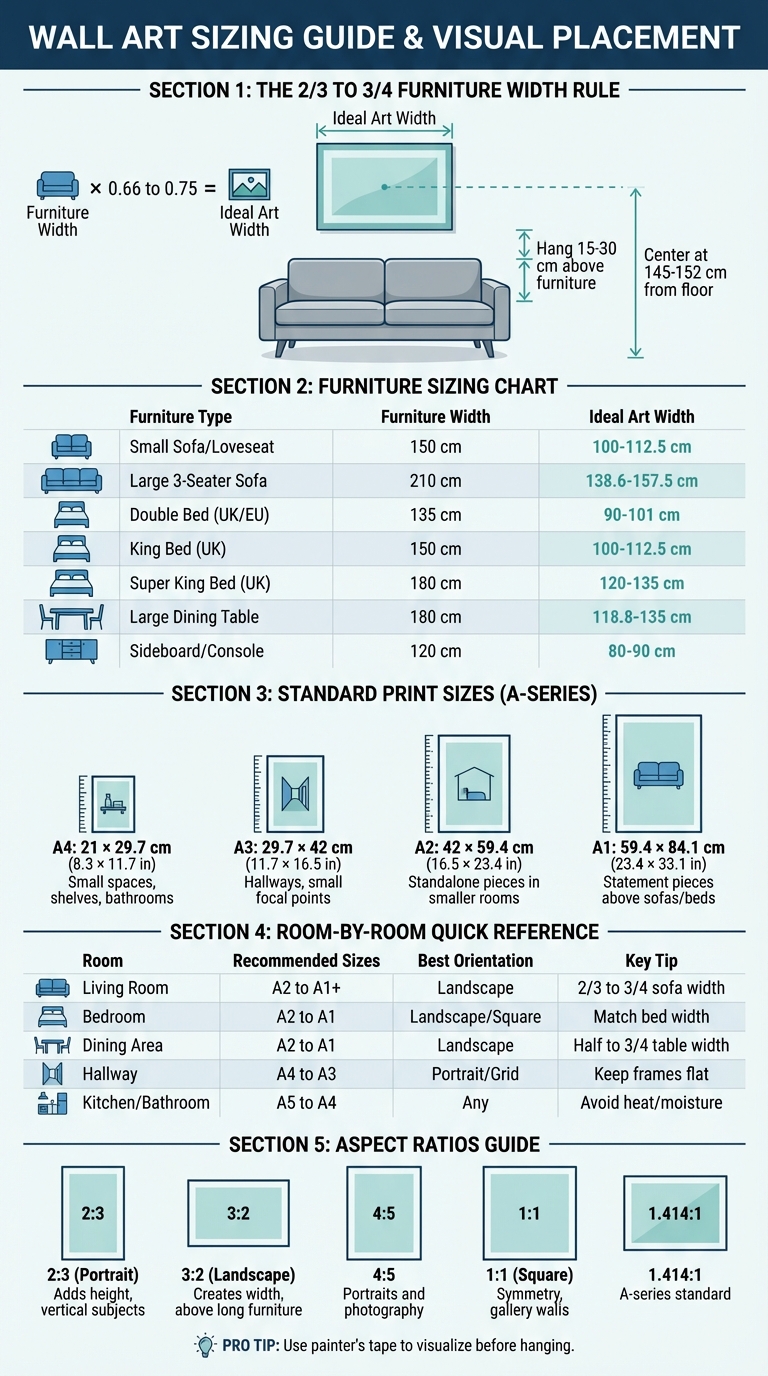
Wall Art Size Guide: Furniture Width Rules and Room-by-Room Recommendations
How to Choose the Perfect Artwork Size for Your Wall | Step-by-Step Guide to Selecting Wall Art
Aspect Ratios and Proportions Explained
Aspect ratio refers to the relationship between the width and height of an artwork, expressed as a ratio (e.g., 2:3, 4:5). It plays a key role in determining how well a piece fits into a space and how it feels within the room.
A well-chosen aspect ratio makes a piece of art feel purposeful and harmonious with the surrounding furniture and room proportions. On the other hand, the wrong ratio can make the artwork appear out of place or awkward. Aspect ratios also influence the atmosphere of a room - larger prints can create a sense of intimacy, while smaller ones can make a space feel more open.
How Aspect Ratios Create Visual Balance
The aspect ratio of a piece can change how it interacts with the room's elements. For example, portrait orientations (taller than they are wide, like 2:3) can add an impression of height to a room, making them ideal for narrow walls or spaces with high ceilings. These ratios are often suited to vertical subjects such as botanical illustrations or tall architectural scenes.
Landscape orientations (e.g., 3:2) have the opposite effect, visually widening a space and creating a grounding feel. They work particularly well above long furniture items like sofas or dining tables, as their proportions echo the dimensions of these pieces. Meanwhile, square formats (1:1) bring a sense of symmetry and balance, making them a great choice for gallery walls where consistency in frame dimensions simplifies the layout.
To ensure your artwork feels well-integrated with the furniture below it, follow the 2/3 rule - art should span about 66% to 75% of the furniture's width. This helps maintain a visually anchored and cohesive look.
Common Aspect Ratios for Wall Art
Familiarity with standard aspect ratios can simplify the process of choosing prints that fit both your space and available frames. Below is a quick reference for common ratios and their typical applications:
| Aspect Ratio | Common Print Sizes | Best Use Case |
|---|---|---|
| 2:3 (Portrait) | 20×30 cm, 40×60 cm, 61×91 cm | Vertical subjects, statement pieces, landscapes, botanicals |
| 3:4 | 23×30 cm, 30×40 cm, 46×61 cm | Versatile, especially for A-series frames |
| 4:5 | 20×25 cm, 40×50 cm, 61×76 cm | Portraits and photography |
| 1:1 (Square) | 30×30 cm, 50×50 cm, 61×61 cm | Symmetrical designs, gallery grids |
In the UK and Europe, A-series paper sizes (A4, A3, A2, A1) follow a distinct 1.414:1 ratio. This unique proportion allows each size to fold neatly into the next, making them highly practical. Frames for these sizes are widely available, and the dimensions suit a variety of styles, from vibrant abstract pieces to cheerful botanical prints.
For interiors with a boho aesthetic, which thrives on an eclectic and layered look, mixing different aspect ratios is key. A large 2:3 focal piece paired with smaller square and 4:5 accents can create the "salon mix" effect that defines this style.
Up next, we’ll explore standard sizes in both metric and imperial units to help you find the perfect fit for your wall.
Standard Wall Art Sizes: Metric and Imperial Measurements
Understanding print dimensions is crucial for choosing the right scale for your space. OMG Kitty offers four standard A-series sizes, all based on the European A-format system, which maintains a consistent 1.414:1 aspect ratio - so, for example, two A4 prints placed side-by-side create one A3 size.
These sizes fall into three practical categories, each tailored to specific uses. A4 prints are ideal for compact areas like bookshelves, bathrooms, or as part of gallery clusters. Medium-sized prints (A3 and A2) are versatile, working well as focal points in smaller rooms or hallways, while also fitting seamlessly into larger gallery walls. Meanwhile, A1 prints are perfect for making a bold statement, whether displayed above sofas, beds, or dining tables.
All OMG Kitty prints are created on high-quality 210gsm poster paper and are hand-designed in Birmingham. A4 prints are delivered flat, while A3, A2, and A1 prints are carefully rolled and shipped in poster tubes. Below is a quick comparison of the available sizes along with their recommended uses.
OMG Kitty Print Size Comparison

| Size | Dimensions (cm) | Dimensions (inches) | Category | Recommended Application |
|---|---|---|---|---|
| A4 | 21 × 29.7 | 8.3 × 11.7 | Small | Desks, bathrooms, bookshelves, or gallery wall clusters |
| A3 | 29.7 × 42 | 11.7 × 16.5 | Medium | Hallways, entryways, or small office walls |
| A2 | 42 × 59.4 | 16.5 × 23.4 | Medium | Stand-alone focal point for small rooms or above narrow consoles |
| A1 | 59.4 × 84.1 | 23.4 × 33.1 | Large | Statement piece above sofas, beds, or dining tables |
To ensure the artwork fits your space, try outlining the dimensions on your wall using painter’s tape. Keep in mind that larger prints like A1 usually require a viewing distance of over 1.5 metres to fully appreciate their impact, while smaller sizes like A4 or A3 are best viewed up close, at less than 1 metre.
sbb-itb-78c8b21
The 2/3 to 3/4 Furniture Width Rule
The 2/3 to 3/4 rule is a simple yet effective guideline for choosing artwork that complements your furniture. It suggests that your art should span between 66% and 75% of the furniture's width. This approach creates a sense of balance, ensuring the artwork doesn't feel too small and lost on a large wall or overpower the furniture beneath it.
"If your artwork is larger than the furniture, then the furniture will seem smaller and less significant. If your artwork is too small, you'll see too much empty wall space, and things will look 'off.'" - Melissa Welsh, Interior Designer, Welsh Design Studio
To find the ideal width, start by measuring your furniture in centimetres. Multiply that by 0.66 for the lower limit and 0.75 for the upper limit. For example, if you have a 210 cm-wide sofa, your artwork should measure between 138.6 cm and 157.5 cm. If you're creating a gallery wall, include the spacing between frames in your measurements to stay within these proportions.
When hanging art, aim for 15–30 cm above your furniture and centre it at a height of 145–152 cm from the floor. Using painter's tape to outline the dimensions on your wall can help you visualise the scale before committing. Let’s see how this rule applies to different furniture types.
Sizing Examples for Sofas, Beds, and Dining Tables
Here’s how the 2/3 to 3/4 rule works for various furniture pieces. For a small sofa or loveseat (about 150 cm wide), artwork spanning 100–112.5 cm is ideal. This could mean using an A1 print (59.4 cm wide) as part of a diptych. A large three-seater sofa (210 cm) would need artwork between 138.6–157.5 cm, such as two A1 prints hung side-by-side with a 5–8 cm gap between them.
The same principle applies to bedroom furniture. A UK double bed (135 cm wide) pairs well with art measuring 90–101 cm, while a super king bed (180 cm wide) calls for something larger, around 120–135 cm. For dining spaces, a 180 cm table works best with artwork between 118.8–135 cm, which could be a single oversized piece or a set of three medium-sized prints.
| Furniture Type | Standard Width (Approx.) | Ideal Art Width (2/3 to 3/4 Rule) |
|---|---|---|
| Small Sofa / Loveseat | 150 cm | 100 cm – 112.5 cm |
| Large 3-Seater Sofa | 210 cm | 138.6 cm – 157.5 cm |
| Double Bed (UK/EU) | 135 cm | 90 cm – 101 cm |
| King Bed (UK) | 150 cm | 100 cm – 112.5 cm |
| Super King Bed (UK) | 180 cm | 120 cm – 135 cm |
| Large Dining Table | 180 cm | 118.8 cm – 135 cm |
| Sideboard / Console | 120 cm | 80 cm – 90 cm |
For wide furniture like sofas and beds, horizontal (landscape) orientation is often the best choice. It mirrors the shape of the furniture, creating a unified look. When it comes to mantels, the artwork should be wider than the fireplace opening but narrower than the mantel, leaving 7.5–15 cm of space above the shelf.
Wall Art Size Recommendations by Room
Choosing the right size for wall art can make or break the vibe of a room. It's all about finding the perfect balance between the art, the wall, and the furniture. By keeping proportion and scale in mind, you can select pieces that fit seamlessly into each room's unique layout.
Living Rooms and Above Sofas
Living rooms typically shine with larger prints like A2 (42 cm × 59.4 cm) or A1 (59.4 cm × 84.1 cm), especially when placed above a sofa. To keep things visually balanced, aim for artwork that spans about 2/3 to 3/4 of the sofa's width. For example, a 183 cm sofa pairs well with art measuring 122–137 cm in total width. You can go with a single oversized piece or a triptych for added flair. Landscape orientation often works best, as it complements the sofa's horizontal shape and gives the room a sense of openness.
Position the bottom of the frame 15–30 cm above the sofa to maintain a visual connection while leaving enough breathing room. Ideally, the centre of the artwork should sit at eye level - around 145–152 cm from the floor. If you have a larger sectional (about 244 cm wide), consider a 61 cm × 91 cm horizontal canvas or even a double-row gallery grid to match the scale.
"Size isn't just about fitting a frame on the wall; it's about balance, harmony, and impact. The wrong size artwork can leave a wall looking cluttered or, worse, bare and uninspired."
- Jason Wickens, Co-founder, Fotoviva Art Prints
Bedrooms and Above Beds
In bedrooms, wall art should complement the width of the bed while following the same 2/3 to 3/4 rule. For a UK queen bed, choose pieces that span 100–112.5 cm in total width. This could mean a single A1 print or two A2 prints with a small gap of 5–8 cm between them. King-sized beds call for larger groupings, with artwork spanning 102–152 cm.
Hang your art 15–30 cm above the headboard for a polished look. Since bedroom art is often viewed while seated or lying down, consider lowering the centre of the artwork to 132–137 cm from the floor for a more comfortable angle. Wide headboards pair well with landscape or square pieces, while vertical art suits narrower single or twin beds. Opt for designs that evoke calm and relaxation.
Dining Areas and Hallways
In dining rooms, the width of your artwork should be about half to three-quarters of the table's width. For a 180 cm dining table, this means selecting pieces that measure roughly 90–135 cm across. A single statement piece or a set of three prints can work beautifully. Horizontal orientations are ideal here, as they echo the table's shape and add a sense of balance.
Hallways, with their narrower dimensions, are perfect for smaller prints like A4 (21 cm × 29.7 cm) or A3 (29.7 cm × 42 cm). Alternatively, a gallery wall with equal-sized pieces can fill a long corridor effectively. Keep the centre of the artwork 145–152 cm from the floor for consistent eye-level viewing. In tight spaces such as stairways, opt for flatter frames to maintain functionality.
Kitchens, Bathrooms, and Small Spaces
Compact areas like kitchens and bathrooms are best suited for smaller prints. Think A4 or even paired A5 pieces that can fit snugly into nooks or shelves. These sizes are ideal for close-up viewing distances of less than 1 metre. You can group a few small prints together or feature one standout piece to brighten up overlooked corners.
When displaying art in these spaces, keep environmental factors in mind. Avoid placing prints near radiators, cookers, or other heat sources, and steer clear of high-humidity areas in bathrooms where moisture can damage frames and warp prints. If you decide to hang art in such conditions, choose spots with good ventilation and consider sealed frames with protective glazing.
| Room Type | Recommended Print Sizes | Best Orientation | Key Consideration |
|---|---|---|---|
| Living Room (Above Sofa) | A2 to A1 (or larger) | Landscape | Follow the 2/3 to 3/4 furniture width rule |
| Bedroom (Above Bed) | A2 to A1 (single or paired) | Landscape or Square | Match bed width; opt for calming designs |
| Dining Area | A2 to A1 | Landscape | Span half to three-quarters of table width |
| Hallway | A4 to A3 | Portrait or Grid | Keep frames flat for functionality |
| Kitchen / Bathroom | A5 to A4 | Any | Avoid direct heat and moisture exposure |
Conclusion
Selecting the right wall art comes down to considering proportion, alignment with furniture, and scaling it to fit each room. The 2/3 to 3/4 rule is a reliable guideline to ensure your artwork feels cohesive with your space, while keeping a gap of 15–30 cm between the frame and nearby furniture creates a sense of balance. Hanging your art so its centre is about 145–152 cm from the floor keeps it at a natural eye level, making it visually pleasing across different areas of your home.
For specific rooms, larger A2 or A1 prints work well above sofas in living rooms, while bedrooms look best with artwork that matches the bed's width. Dining areas benefit from horizontal pieces, and smaller A4 prints are ideal for compact spaces. These tips can help you make informed decisions as you finalise your choices.
To avoid mistakes, try mocking up your art dimensions with painter's tape to see how they look from different angles. If you're unsure, going for a slightly larger piece or grouping smaller prints often creates a more harmonious look than leaving walls too empty.
For those looking to bring these principles to life, OMG Kitty offers a range of sustainably made-to-order prints in standard sizes like A4, A3, A2, and A1. Designed by Kitty in her Birmingham studio, these pieces combine premium giclée printing with eco-conscious practices. With glowing reviews for paper quality and vibrant designs, plus free UK delivery and worldwide tracked shipping, prices start at around £25 - making it easy to add gallery-worthy art to any room.
FAQs
How can I choose the right size of wall art for my space?
Choosing the right size for wall art means thinking about the proportions of your wall, furniture, and the overall layout of the room. A good guideline is to have the artwork cover about 60-75% of the available wall space. This helps create a balanced and pleasing look. If you're placing art above furniture, aim for it to be half to two-thirds the width of the furniture. This way, the art complements the space without feeling overpowering.
Start by taking precise measurements of your wall, including the ceiling height, wall length, and any features like windows or doors. If you're planning a gallery wall or using multiple pieces, make sure to leave consistent spacing between them to keep the arrangement visually appealing. By keeping these tips in mind, you can design a space that feels stylish and well put together, whether it's in your living room, bedroom, or office.
For those after premium, sustainably-made art prints, take a look at OMG Kitty. This UK-based shop offers vibrant, uplifting designs, all hand-crafted to order. They provide framed and unframed options, with worldwide tracked delivery available.
What is the 2/3 to 3/4 rule for placing wall art above furniture?
The 2/3 to 3/4 rule is a handy guideline for selecting the right size of wall art to hang above furniture. The idea is straightforward: the width of your artwork should be about two-thirds to three-quarters of the width of the furniture beneath it. This approach helps create a balanced and visually pleasing arrangement.
For instance, if your sofa measures 200 cm in width, your wall art should ideally fall between 133 cm and 150 cm wide. This ensures the piece complements the furniture and the room, avoiding the extremes of being too small or overpowering. Following this rule can help create a harmonious and inviting atmosphere in your space.
Why does the aspect ratio matter when selecting wall art?
When selecting wall art, the aspect ratio plays a key role in achieving a balanced and proportional look. Getting this right ensures that the artwork fits seamlessly into your space without appearing stretched, cramped, or out of place. It’s all about creating a visually pleasing harmony.
Take larger walls, for instance - they often work best with wider or panoramic pieces that fill the space without overwhelming it. On the other hand, smaller areas might shine with compact or vertically oriented designs. Choosing the right proportions not only elevates the room’s aesthetic but also makes the art feel like an organic part of your decor.