

When choosing between recycled paper and canvas for art prints, your decision should depend on the artwork's style, display environment, durability needs, and budget. Here's a quick breakdown:
- Recycled Paper: Best for detailed, high-definition prints like photography and illustrations. Its smooth matte finish enhances colour and detail but requires framing for protection. It's lightweight, cost-effective, and eco-friendly, but sensitive to moisture and damage.
- Canvas: Ideal for larger, statement pieces or textured artwork like landscapes and oil painting reproductions. Canvas is durable, glare-free, and doesn’t need glass framing. However, it softens fine details, costs more upfront, and requires more space due to its depth.
Quick Comparison Table
| Feature | Recycled Paper | Canvas |
|---|---|---|
| Texture | Smooth, flat surface | Woven, textured finish |
| Detail Clarity | Sharp and precise | Slightly softened by texture |
| Durability | Fragile; needs glass protection | Durable; resists wear |
| Best Use | Photography, detailed prints | Abstracts, paintings |
| Cost | Lower upfront cost | Higher upfront cost |
| Maintenance | Requires framing; careful handling | Simple dusting |
Recycled paper suits controlled environments like studios or offices, while canvas works better in high-traffic or humid spaces like living rooms. Both options offer eco-conscious choices, but paper has a lower production footprint, while canvas lasts longer. Choose based on your artwork's needs and display conditions.
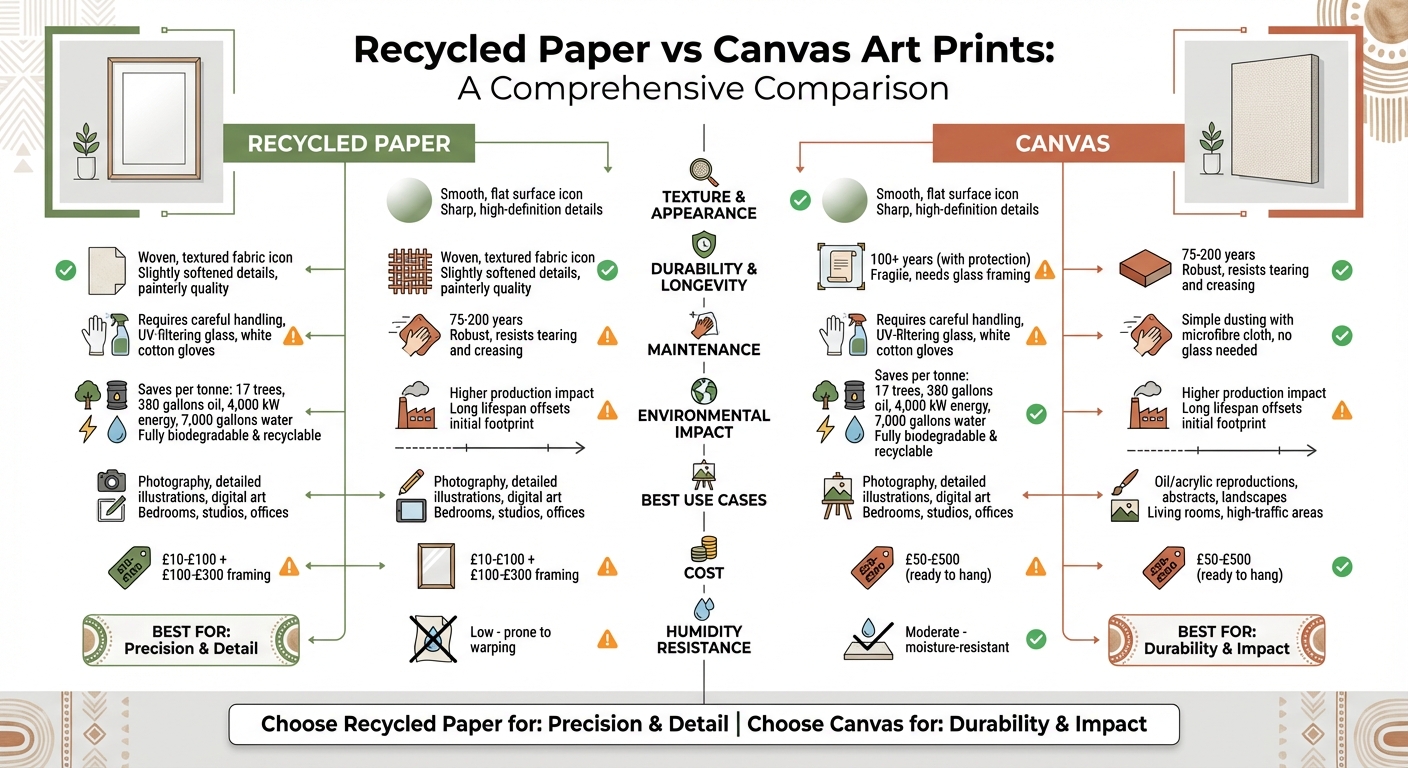
Recycled Paper vs Canvas Art Prints Comparison Chart
Paper or Canvas. I offer both types of Art Prints.
sbb-itb-78c8b21
Recycled Paper Prints
Recycled paper offers a smooth matte finish that sharpens intricate details and enhances colour vibrancy. Silk-coated variations, crafted from 100% recycled pulp, reduce ink absorption, resulting in clearer lines and more vivid images. This makes recycled paper a perfect choice for detailed boho-style designs, photography, and illustrations where precision is key.
The environmental benefits of recycled paper are impressive. Producing one tonne of recycled paper can save 17 trees, 380 gallons of oil, 4,000 kilowatts of energy, and 7,000 gallons of water. Compared to virgin fibre production, it typically uses less water and has a smaller carbon footprint. Some options, like limestone-based paper, go even further by using 97% less water during manufacturing. At OMG Kitty, our recycled paper prints are made using FSC-certified fibres and renewable energy, ensuring a reduced environmental impact. These eco-friendly qualities make recycled paper an excellent choice for precision-driven art prints.
Benefits of Recycled Paper
Recycled paper isn’t just eco-conscious - it’s also artistically practical. Its matte finish eliminates glare, making it ideal for brightly lit spaces. The smooth surface enhances colour accuracy and tonal variation, which is essential for artwork with subtle gradients or intricate patterns.
It’s also lightweight and cost-effective, making it a great option for larger prints or gallery walls. High-quality, acid-free recycled paper can last over 100 years without yellowing or fading when properly cared for. Plus, the variety of finishes available - from ultra-smooth coated options to more textured, natural-looking stocks - provides flexibility to suit different artistic styles.
Limitations of Recycled Paper
While recycled paper has many advantages, it does require careful handling. It’s prone to creasing and damage, so framing behind glass or acrylic is recommended for protection. Without this, exposure to dust, humidity, and UV light can lead to degradation over time.
Moisture is a particular concern, as recycled paper absorbs it quickly, which can cause warping or surface wear. This makes it less suitable for high-humidity areas like kitchens or bathrooms unless properly sealed. Additionally, some recycled papers may have visible flecks or darker fibres from the recycling process and tend to have a slightly off-white or greyish tone rather than a bright white. While this can subtly alter colour appearance, it also adds a natural, organic charm.
Canvas Prints
Canvas offers a tactile, three-dimensional quality that enhances the appeal of art prints. Its woven texture gives prints a finish that feels closer to original paintings than standard reproductions. This feature adds depth and personality, making canvas prints an excellent choice for boho or artistic interiors that lean towards a handcrafted, artisanal vibe.
Stretched over wooden frames, canvas prints have a physical depth that creates a striking visual impact. This makes them particularly well-suited for spaces with plenty of natural or varied lighting. At OMG Kitty, we use premium giclée printing techniques to ensure vibrant colours and sharp details, perfectly complementing our boho-inspired designs. Below, we explore the benefits and challenges of canvas prints to help you decide if they’re the right fit for your space.
"Canvas printing produces a more tactile and artistic look. The woven surface adds depth and texture, creating a painterly quality that transforms digital images into gallery-worthy pieces." – Christopher Abbott, Founder, The Stackhouse Printery
Benefits of Canvas
Archival-quality canvas prints can last 50–100+ years when kept indoors and away from direct sunlight, thanks to pigment-based inks, UV-resistant coatings, and kiln-dried stretcher bars.
The material is naturally durable, standing up well to everyday wear and tear. Unlike paper, canvas resists tearing, shrinking, and buckling, making it a great option for busy households or spaces with children and pets. Maintenance is simple - just a quick dusting with a soft microfibre cloth will keep it looking its best, and there’s no glass to clean or worry about.
Canvas also offers versatile display options. You can opt for a frameless, gallery-wrapped style for a minimalist look, or add a floating frame for a more polished finish. Without the need for glass, canvas prints are often a more affordable choice for larger artworks, where heavy glass and framing can drive up costs significantly.
However, canvas isn’t without its drawbacks.
Limitations of Canvas
Canvas prints tend to be pricier than paper options. While the durability and presentation justify the cost, it might not be the best choice for those looking to create a gallery wall with multiple smaller pieces.
Another consideration is the canvas' physical depth. The stretcher bars mean it protrudes further from the wall, which requires a bit more space. The textured surface can also soften fine details, making it less suitable for prints that depend on intricate precision. And while canvas handles moderate humidity better than unprotected paper, excessive moisture can lead to sagging or mould. Avoid placing canvas prints in bathrooms or directly above radiators.
Durability Comparison
When it comes to durability, canvas and recycled paper have distinct qualities. Canvas stands out for its resilience, while recycled paper, though capable of lasting over a century with proper care, demands more attention.
Canvas prints can endure for 75 to 200 years indoors. High-quality giclée canvases are known for their longevity, withstanding between 75 and 200 years indoors. The woven fabric offers excellent resistance to tearing, creasing, and buckling - qualities that make it more robust than paper. As artist Kerwin Blackburn puts it:
"Giclée-printed colours can last for over 200 years (my own range of By Kerwin canvas giclée prints offer a colour guarantee of 100 years)".
Paper prints, while capable of lasting over 100 years when protected, are far more delicate. They are prone to creasing, tearing, and moisture damage. Without proper framing behind UV-filtering glass, paper absorbs moisture easily, leading to splitting or warping.
Maintenance requirements also differ significantly. Canvas prints are low-maintenance, needing only occasional dusting. In contrast, paper prints demand careful handling with white cotton gloves and should be framed behind UV-filtering glass to minimise damage.
Durability Comparison Table
| Factor | Recycled Paper | Canvas |
|---|---|---|
| Longevity | 100+ years (if acid-free and protected) | 75–200 years |
| Resistance to Humidity | Low; prone to splitting and warping | High; moisture-resistant when treated |
| UV Light Resistance | Limited; requires glass protection | Strong; often enhanced with UV varnish |
| Physical Durability | Fragile; creases and tears easily | Robust; resists creasing and tearing |
| Maintenance | Requires careful handling and professional care | Simple dusting with a dry microfibre cloth |
These durability traits are an important complement to the aesthetic and environmental considerations discussed earlier.
Appearance Comparison
Understanding the visual differences between recycled paper and canvas can help you choose the right medium for your artistic needs.
Paper provides a smooth, flat surface that captures every detail with precision. Its sleek finish is perfect for crisp edges and intricate details, making it ideal for high-definition photography and detailed illustrations. Some fine art papers even mimic the texture of traditional watercolour paper, while still offering more clarity than canvas. Christopher Abbott, Founder of The Stackhouse Printery, notes:
"Smooth papers show maximum detail and crisp edges. Textured papers add a traditional fine art feel and can slightly soften very fine detail".
Canvas, on the other hand, has a woven texture that adds depth and a painterly quality. This tactile surface creates a three-dimensional effect, giving digital prints the feel of original paintings. However, there’s a trade-off:
"The textured surface of canvas means ultra-fine details aren't as crisp as they would be on paper", explains Puja Khetrapal, artist at Art by Affie.
Canvas is particularly well-suited for abstract art, landscapes, and reproductions of oil or acrylic paintings, where its texture enhances the overall aesthetic.
Colour presentation also varies between the two materials. Paper excels in delivering accurate colours and smooth tonal transitions, while canvas offers a richer, warmer feel with excellent colour retention. Matte paper is glare-free, making it a great choice for brightly lit spaces, whereas canvas manages glare effectively without needing glass protection.
Appearance Comparison Table
| Factor | Recycled Paper | Canvas |
|---|---|---|
| Texture | Smooth to lightly textured; flat surface | Woven, bumpy, tactile fabric feel |
| Detail Clarity | Sharp, high-definition; preserves fine lines | Slightly softened by fabric weave |
| Colour Quality | Exceptional accuracy; rich, smooth tones | Excellent retention; adds depth and warmth |
| Visual Effect | Sleek, modern, professional appearance | Painterly, artsy, substantial presence |
| Glare Resistance | Excellent with matte finish | High; no glass needed |
| Best Art Style | Photography, detailed illustrations, digital art | Oil/acrylic reproductions, abstracts, landscapes |
Best Spaces for Each Material
Indoor Spaces
Recycled paper prints are best suited to areas with stable, low-humidity conditions like bedrooms, art studios, or professional offices. These environments help protect the prints from moisture and temperature changes, which can lead to warping or yellowing over time.
To preserve recycled paper prints, consider framing them with UV-protective glass or acrylic. This not only safeguards the artwork but also ensures durability, even in busier spaces. For boho-inspired interiors, textured fine art papers such as Cold Press or cotton rag varieties bring a handcrafted, natural touch. These papers, reminiscent of traditional watercolour surfaces, are perfect for smaller spaces where their subtle texture can shine. However, steer clear of placing paper prints in poorly ventilated bathrooms, as the steam and humidity can damage the paper fibres.
For areas that experience heavier use, canvas prints offer a more durable alternative.
High-Traffic or Variable Areas
While recycled paper thrives in controlled environments, canvas is built for spaces with more dynamic conditions. Canvas prints are ideal for high-use areas like living rooms and hallways, thanks to their woven structure, which resists tearing and creasing.
Canvas also performs better in spaces with fluctuating humidity, such as kitchens or larger bathrooms. However, it’s still wise to avoid placing canvas pieces in areas prone to excessive moisture. In boho-style living rooms filled with natural light, the textured and dimensional quality of canvas creates a bold focal point, making it an excellent choice for spaces above sofas or beds.
As Puja Khetrapal from Art by Affie notes:
"Because framed paper prints sit flatter, they can feel more blended into the décor rather than protruding like a canvas".
When you want your art to make a statement, canvas delivers a striking, gallery-like presence.
| Feature | Recycled Paper | Canvas |
|---|---|---|
| Best Room Environment | Stable, low humidity (bedrooms, studios) | Variable humidity (living rooms, large kitchens) |
| Foot Traffic Suitability | High (if framed behind glass for easy cleaning) | Low to medium (prone to scratches) |
| Humidity Resistance | Low; requires sealed framing | Moderate; moisture-resistant but avoid extreme dampness |
| Visual Impact | Sleek, integrated, detailed | Bold, textured, dimensional |
| Maintenance | Easy to wipe glass; protects artwork | Harder to clean; dust collects in weave |
Explore our premium art prints at OMG Kitty.
Environmental Impact Comparison
When it comes to sustainable art practices, the environmental effects of your chosen medium are just as important as its appearance and durability. Comparing recycled paper and canvas reveals that their environmental footprints go far beyond the final product.
Recycled paper has a clear advantage in terms of production. It requires less energy and water since the fibres have already been extracted. As the Environmental Paper Network puts it:
"Making paper from used paper is generally cleaner and more efficient than making paper from trees, since much of the work of extracting and bleaching the fibres has already been done."
Every tonne of recycled paper saves approximately 17 trees, 1,440 litres of oil, 4,000 kilowatts of energy, and 26,500 litres of water. Some recycled papers go even further by incorporating up to 15% food by-products - like citrus peel or coffee grounds - or 30% seaweed, reducing the need for virgin wood pulp.
Canvas, on the other hand, demands more resources upfront. The process involves growing cotton or linen, weaving the fabric, and applying acrylic gesso coatings, all of which contribute to a higher carbon footprint. However, canvas's durability can make up for this over time, as its long lifespan means it rarely needs replacing.
At the end of its life, recycled paper is fully biodegradable and easily recyclable within standard municipal systems. Canvas disposal is more complex. While 100% cotton or linen canvases are biodegradable, polyester blends (which can be recycled under PET code 1) and canvases with coatings can complicate the process. In the UK, about 67% of industrially sourced paper carries FSC or PEFC certification, ensuring sustainable forest management.
Here's a quick breakdown:
| Factor | Recycled Paper | Canvas |
|---|---|---|
| Production Impact | Lower energy and water use; less chemical processing | Higher impact from farming, weaving, and gesso coatings |
| Renewability | Made from waste paper or alternative plant fibres | Cotton and linen are renewable; polyester blends are petroleum-based |
| End-of-Life | Fully biodegradable and recyclable in standard systems | Natural fibres biodegrade; polyester recyclable but coatings complicate processing |
| Longevity | Delicate; may need replacing if damaged | Extremely durable; can last decades |
| Carbon Footprint | Lower overall; fibres already processed | Higher initial emissions but offset by long lifespan |
This comparison shows how recycled paper's lower production impact contrasts with the long-term durability of canvas. For sustainably made-to-order prints, check out OMG Kitty, where every piece is hand-designed in the UK.
How to Choose Between Them
When deciding between recycled paper and canvas, it all comes down to the type of artwork, where it will be displayed, and your budget. Recycled paper is ideal for high-resolution, detailed pieces and smaller works, while canvas suits larger statement pieces or reproductions of oil and acrylic paintings. Canvas also offers the option of a sleek, frameless display.
Budget is another key factor. Recycled paper prints typically range from £10 to £100, with framing adding an extra £100–£300. Canvas prints, on the other hand, cost between £50 and £500 and are often ready to hang without additional framing costs.
"The choice between a paper print and a canvas is a personal decision. Many people prefer the wrapped canvas because of the texture in the canvas that brings the artwork to life." - Susan Newberry, Susan Newberry Designs
Think about your space. Rooms with lots of natural light or windows may benefit from canvas prints, as they avoid the glare often caused by glass-covered paper prints. Canvas is also better suited for humid environments, while paper requires glass protection to prevent curling or mould. Additionally, smaller prints (under 8×10) tend to look better on paper, as tiny canvases can feel out of place without the added structure of a frame and mat.
At OMG Kitty, all prints are created using giclée printing on both recycled paper and canvas. This ensures archival quality with vibrant, long-lasting colours. Whether you prefer the clean detail of paper or the textured depth of canvas, each piece is crafted sustainably in the UK. Available in sizes from A4 to A1, you can choose framed or unframed options to suit your style and space.
FAQs
How do I choose between recycled paper and canvas for my artwork?
When choosing between recycled paper and canvas, think about durability, appearance, and where the piece will be displayed.
- Recycled paper has a smooth, refined texture that works well for intricate details and custom framing. It's also often more budget-friendly.
- Canvas, on the other hand, offers a textured, sturdy surface that creates a gallery-style look, making it ideal for larger, impactful pieces.
Your decision should align with the style of your artwork, your budget, and the environment where it will be showcased.
What framing or protection does a recycled paper print need?
To keep a recycled paper print in good condition, use a frame with UV-protective glass or acrylic to shield it from fading. Opt for acid-free backing and matting to prevent any chemical damage. Place the print in a stable environment, avoiding direct sunlight, high temperatures, or humidity. Using archival, acid-free materials ensures the print maintains its quality and stays visually appealing over time.
Will canvas reduce the sharpness of detailed images?
Canvas can indeed soften the sharpness of detailed images. Its textured surface introduces a sense of depth and dimension but can blur fine details when compared to the smooth finish of paper. This quality makes canvas a great choice for artwork with bold strokes or less intricate designs, while paper is better for maintaining crisp, highly detailed visuals.