

Creating high-quality boho art prints involves more than just artistic design - it’s about precision in every detail, from file preparation to packaging. Here’s what you need to know:
- File Preparation: Use 300 DPI resolution, CMYK colour mode, and formats like PDF or TIFF for professional results. Ensure files are properly aligned, with embedded fonts, and include bleed margins.
- Materials: Opt for acid-free, archival-grade paper (200–300 gsm) with a matte or lightly textured finish to preserve colours and prevent yellowing over time. Pigment-based inks ensure long-lasting vibrancy.
- Printing Standards: Giclée printing is ideal for capturing the earthy tones and patterns of boho art. Test prints and calibration checks help maintain colour accuracy and sharpness.
- Packaging: Protect prints with acid-free tissue, rigid backing boards, and resealable sleeves. Use sturdy mailers or postal tubes and eco-friendly materials.
- Consistency: Maintain uniformity across batches by using master reference prints, spectrophotometers for colour checks, and detailed process documentation.
These steps ensure your boho art prints meet high standards, delighting customers with beautiful designs, durable materials, and careful presentation.
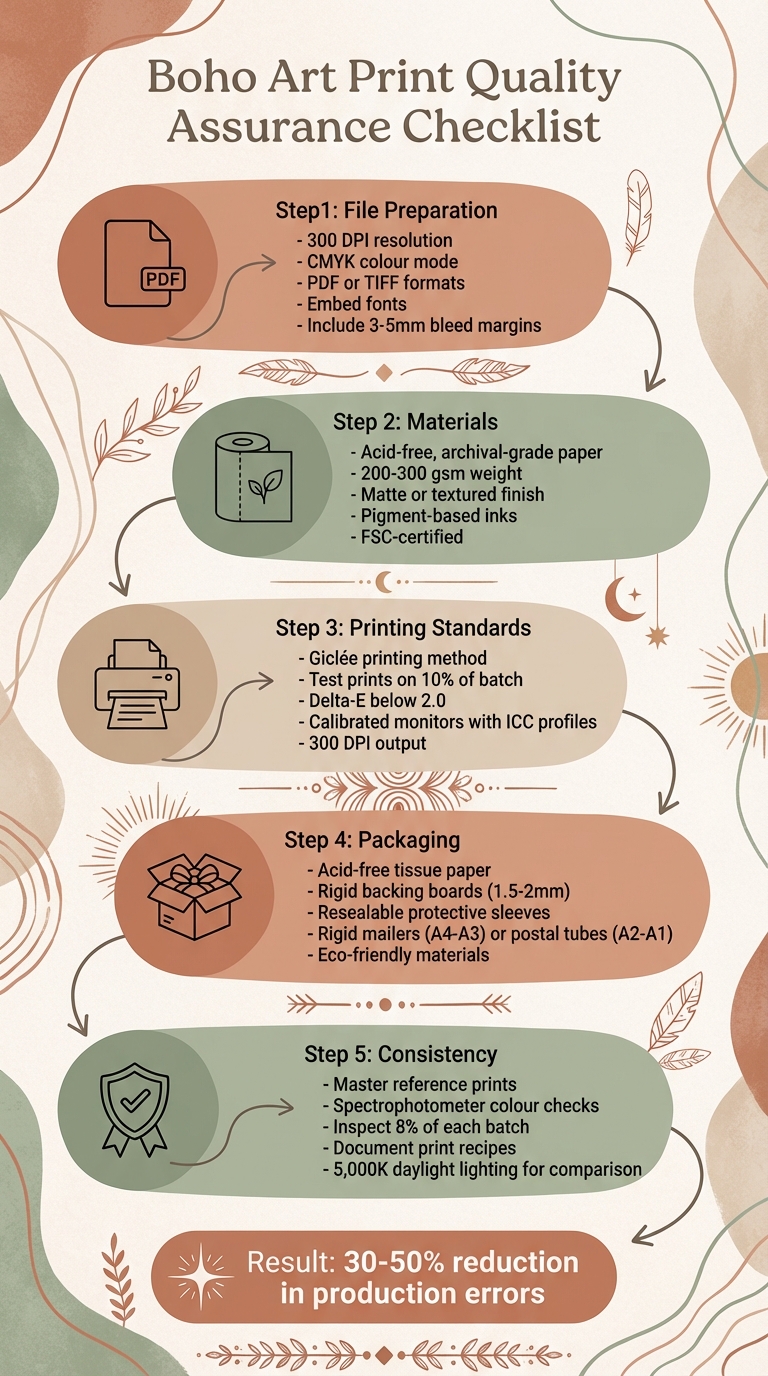
5-Step Quality Assurance Checklist for Boho Art Prints
Guide to Fine Art Printing – Everything You Need to Know
Design and File Preparation
Getting your design files right from the beginning can save a lot of headaches and unnecessary expenses later. The key to creating high-quality boho prints lies in thorough file preparation - before any ink touches paper. These careful steps form the backbone of quality control, earning trust and positive feedback from customers.
Resolution, Dimensions, and File Format
Using high-resolution files at 300 DPI ensures your designs stay crisp and clear, even when scaled to standard UK sizes like A4 (210×297 mm), A3 (297×420 mm), A2 (420×594 mm), and A1 (594×841 mm). These ISO A-series sizes stick to a 1:√2 aspect ratio, which keeps your boho prints looking proportional and visually pleasing across all formats.
It’s also helpful to prepare files in other popular aspect ratios to make framing and cropping easier for customers. For file formats, PDF and TIFF are the top choices for professional printing. They preserve quality, embed fonts properly, and support high DPI without losing detail. While high-resolution JPGs (300 DPI) are fine for digital downloads, sticking with PDF or TIFF formats helps avoid issues like colour shifts or banding in textured boho designs during printing.
Colour and Texture Alignment
Always convert your files to CMYK before sending them off for printing. While RGB works well for screens, it doesn’t translate accurately to ink-based printing. CMYK ensures your warm terracotta tones, earthy greens, and botanical shades - hallmarks of the boho aesthetic - come out as intended. What looks perfect on your monitor in RGB could print dull or off-tone in CMYK if the conversion isn’t handled properly.
Pay close attention to banding and texture distortion, especially in organic patterns. These issues often stem from low resolution or heavy compression. To avoid them, use gradient tools in your design software and proof your files at their actual size. This helps you spot and fix any problems early on.
Final File Verification
Before you hit “send,” run through this quick checklist:
- Ensure the file is set to 300 DPI and converted to CMYK.
- Embed fonts or convert them to outlines.
- Include proper clipping paths and add 3–5 mm bleeds.
- Name files clearly, including the version date (e.g., DD/MM/YYYY).
Organising your files into folders by size (e.g., A4–A1) or batch makes it easier to manage orders. Soft-proof the files on-screen, and print an A4 test sample on the paper stock you plan to use. This helps you catch any last-minute colour or alignment issues before committing to full production.
At OMG Kitty, we take pride in these detailed preparations, ensuring every boho art print meets the high standards our customers deserve. With your files perfected, the next step is to ensure your materials and printing process maintain the same level of quality.
Materials and Printing Standards
Choosing top-tier materials and adhering to strict printing standards ensures that every boho art print upholds the quality OMG Kitty customers trust. These practices are a key part of a thorough quality assurance process.
Paper Selection and Durability
The right paper is crucial for creating boho art prints that remain vibrant and long-lasting. For this, archival-grade fine art paper is non-negotiable - it must be acid-free and lignin-free to prevent yellowing or degradation over time. A weight range of 250–310 gsm is ideal, with 270 gsm cardstock offering a luxurious feel and excellent resistance to creasing during handling or framing.
A matte or satin finish complements the boho aesthetic beautifully, enhancing warm terracotta tones and earthy neutrals without causing glare or reflections. Opt for paper certified by the FSC (Forest Stewardship Council) or Rainforest Alliance to ensure responsible sourcing and professional-grade quality. Customers often highlight the durability and rich colour of heavyweight, FSC-certified stock as standout features.
To ensure quality, test paper samples by folding and handling them - premium stock should resist cracking or tearing. Additionally, confirm the paper’s pH neutrality (between 7–9) and compliance with ISO 9706 standards, which guarantee fade resistance for over 75 years. At OMG Kitty, we exclusively use archival paper that meets these benchmarks, ensuring every print retains its beauty for decades.
Once the ideal paper is selected, the focus shifts to achieving impeccable print quality.
Print Quality Control
After securing high-quality paper, the printing process must meet equally high standards. Giclée printing is the preferred method, as it uses archival pigment inks to produce high-resolution, richly layered colours. This technique captures the organic, hand-crafted essence of boho designs while avoiding issues like banding or colour distortion.
Before starting a full production run, test prints are essential. Use calibrated monitors and ICC profiles to check for colour accuracy - what looks perfect on screen can differ significantly when printed. Assess sharpness at 300 DPI to avoid pixelation, and ensure alignment is precise so edges remain crisp and free from defects. Professional setups aim for a delta-E colour deviation below 2, ensuring precise colour matching. By running test prints on 10% of the batch, you can catch any calibration issues early, saving time and materials while delivering the consistent quality your customers expect.
sbb-itb-78c8b21
Packaging and Presentation
Once your boho art prints are crafted to perfection, the next step is making sure they arrive in pristine condition while offering a memorable unboxing experience. Thoughtful packaging not only protects your prints but also reflects the care and attention poured into their creation.
Protective Packaging Materials
To guard against shipping risks like bending, creasing, or moisture, it’s crucial to use the right materials. Begin by wrapping each print in acid-free tissue paper - this prevents scuffs and colour transfer while ensuring long-term preservation without yellowing. Next, place the wrapped print in a clear, resealable protective sleeve made from archival-quality polypropylene. Add a rigid backing board (1.5–2 mm greyboard or pH-neutral mountboard) cut to the exact size of the print for extra stability.
For smaller prints (up to A3), opt for rigid flat mailers or board-backed envelopes that can withstand bending. Clearly label these with "Do Not Bend" on multiple sides to ensure careful handling, especially when using UK Royal Mail services. Larger prints (A2–A1) are best shipped in heavy-duty postal tubes to prevent folding or corner damage. Roll these prints loosely around a 50–70 mm diameter core with the image side facing out, and include instructions advising customers to flatten the print under a clean, weighted surface for 12–24 hours before framing.
International orders may require extra protection, as parcels often face more handling and potential humidity changes. Add sealed poly or glassine bags as moisture barriers and reinforce the tube ends with additional padding. Before committing to a packaging supplier, test sample parcels by lightly dropping and bending them to ensure durability. To align with eco-conscious values, choose FSC-certified cardboard, recycled backing boards, and paper tape instead of plastic materials. This approach resonates with UK consumers, 67% of whom prioritise environmentally friendly packaging when shopping online, according to a 2022 YouGov survey. Sustainable choices also complement the boho aesthetic and values embraced by brands like OMG Kitty, known for their made-to-order prints.
Labelling and Presentation
Clear and precise labelling is essential to avoid mix-ups and ensure customers can identify their prints at a glance. On the outer packaging, include the full delivery and return address, along with any necessary customs documentation (CN22/CN23 for non-UK shipments). Prominent handling instructions such as "Fragile – Art Print Inside", "Do Not Bend", and "Keep Dry" should be placed on multiple sides in a readable font. For tracked services, ensure barcodes lie flat and aren’t positioned over seams or curved surfaces to facilitate smooth scanning.
Inside the package, include a simple insert detailing the print’s title, size, orientation, and the OMG Kitty brand name. This helps customers organise their collection and makes reordering effortless. A care card is another thoughtful addition, offering guidance on safely opening the package, removing protective sleeves without touching the printed surface, and handling the print by its edges with clean, dry hands. Include tips on framing, such as using acid-free mounts and UV-filter glazing, and advise against exposing prints to direct sunlight, damp areas, or heat.
To elevate the unboxing experience, incorporate design elements that reflect the boho vibe. Use earthy or pastel tissue paper, kraft materials, and minimalist thank-you cards. Keep embellishments flat to avoid creating pressure points on the print. One OMG Kitty customer review highlights the impact of such attention to detail:
My order was well packaged and arrived promptly. I will definitely be a repeat customer and will recommend to others too!
This kind of feedback underscores how well-thought-out packaging can boost customer satisfaction and loyalty. To streamline your process as orders grow, standardise a few packaging "kits" for different size categories (A4–A3 flat, A2–A1 rolled).
With packaging and presentation perfected, the next step is ensuring consistent quality in every batch.
Maintaining Consistency Across Batches
Ensuring that every boho art print batch matches perfectly across sizes and orders is essential for maintaining customer trust and upholding your brand's reputation. To achieve this, it’s critical to standardise your process and rigorously check every batch against a reliable reference. By adhering to strict design and printing protocols, you can guarantee uniformity across all prints.
Colour and Size Consistency
Start by creating a master reference print for each design using your standard paper, printer, and settings. Store this print in an acid-free sleeve, away from sunlight, and in an environment with less than 50% relative humidity (RH). Clearly label it with details like the batch date, printer settings, and ink lot numbers. Before beginning any print run, perform routine printer checks and print 2–3 test sheets. Compare these test prints side-by-side with your master reference under 5,000K daylight lighting - avoid household bulbs, as their warm tones can distort colour perception. This ensures any shifts in saturation or hue are easily detected.
For designs offered in multiple sizes, such as A4 through to A1, print a sample of each size and compare them directly. Larger formats like A1 can reveal issues such as scaling artefacts or uneven ink density that might not be noticeable on smaller sizes like A4. This is especially crucial for intricate boho patterns featuring vibrant tones like terracotta or sage green. Use digital callipers to check dimensions at several points, ensuring A4 prints are accurate to within ±0.5 mm and A1 prints within ±1.5 mm. For precise colour matching, use a spectrophotometer to measure key colours, aiming for a Delta E value below 2.0, which ensures any differences are virtually undetectable to the human eye.
Once physical and colour standards are verified, document all process details to maintain consistency across future batches.
Batch Quality Control
Create a print recipe for every design, including details like printer model, firmware version, ink density (typically 120–150% total ink limit for matte papers), ICC colour profile (e.g., ISO Coated v2 for UK printers), resolution (300 DPI at the final size), and environmental conditions (20–24°C, 40–60% RH). If any deviations occur, record them immediately in the batch log.
Inspect 8% of each batch, selecting samples from the beginning, middle, and end of the run. Compare these against your reference print, checking for colour accuracy, precise dimensions, and defects like banding, mis-registration, or smudging. If more than 2% of the batch fails your quality standards, reject the entire batch. Always use the same paper brand, weight (e.g., 200–300 gsm), whiteness, and surface finish for all reprints. Should you need to switch materials, produce and approve a new master reference print before proceeding.
This meticulous approach is particularly important for made-to-order businesses like OMG Kitty, where customers expect their hand-designed boho prints to be identical, whether they’re ordering for the first time or returning months later.
Conclusion and Key Takeaways
Ensuring flawless boho art prints starts with a solid quality checklist. From confirming a 300 DPI resolution and CMYK colour modes during file preparation, to choosing acid-free papers, monitoring print output, and using sturdy packaging to protect the final product - each step plays a vital role in avoiding defects. For boho designs with intricate patterns and rich earthy tones, these measures safeguard both artistic detail and the durability that customers expect.
These quality checks do more than just guarantee exceptional prints - they help establish trust with customers. By implementing rigorous quality control, businesses can achieve consistent results that not only inspire confidence but also drive repeat purchases and glowing reviews. In fact, thorough checks on files and materials can cut production errors by 30–50%, reducing waste and supporting eco-conscious, made-to-order practices.
At OMG Kitty, quality is at the heart of every boho print. Each piece is crafted to order in Birmingham using premium giclée techniques and carefully selected materials. Customers frequently leave 5-star reviews, praising the vibrant colours, exceptional paper quality, and thoughtful packaging.
Whether producing A4 prints or larger A1 formats, maintaining consistency across batches is crucial. Techniques like master reference prints, spectrophotometer checks, and documented print recipes ensure every order meets the same high standards. Paired with worldwide tracked shipping and secure packaging, this meticulous attention to detail turns quality control into a competitive edge. From file preparation to the final delivery, every step reflects a commitment to excellence that customers notice and appreciate.
FAQs
Why is giclée printing ideal for boho art prints?
Giclée printing works wonderfully for boho art prints, offering vivid colour precision, fine details, and a high-quality finish. This technique ensures your artwork remains vibrant and durable, resisting fading to keep its charm intact for many years.
What’s more, giclée printing often incorporates eco-conscious materials and methods, making it a thoughtful option. This aligns naturally with the boho vibe, which celebrates mindfulness and a deep connection to nature.
How can I make sure my boho art prints have consistent colour quality every time?
To ensure your boho art prints maintain consistent colour quality across every batch, rely on giclée printing with well-calibrated printers. It's crucial to standardise your colour profiles and conduct regular colour matching tests for each batch to avoid any surprises.
Keeping your printing equipment in excellent shape is equally important. Schedule routine maintenance and calibration to prevent any issues. Using colour management software can also be a game-changer, helping you monitor and maintain colour accuracy throughout the process. These practices will ensure your prints remain vibrant and consistent, batch after batch.
What’s the best way to package art prints to ensure they arrive in perfect condition?
To ensure your prints arrive safely, opt for durable, acid-free materials such as corrugated cardboard or kraft paper for padding. Carefully wrap the print in bubble wrap or tissue paper to shield it from scratches or creases. Make sure the packaging is tight and well-cushioned to minimise movement and reduce the risk of damage during transit.